
Schneider Just Paid $22.6 Billion for the Architecture. Who Owns the Rights Underneath It?
A 23-year Rockwell Automation veteran reads the Schneider-PTC deal as the clearest public validation yet of the Strong Force thesis, and asks the question every operator should be asking now.
Part 2 of 2. Start with Part 1: I Went Looking for a Way to Protect My IP in the Age of AI. I Didn’t Expect to Find the Alpha Asset in the Room.
In July, I wrote about a conversation with Richard Spitz of Strong Force Innovation Portfolios. I went looking for a way to protect my IP in the age of AI, and I came away with a thesis I couldn’t shake: AI models are becoming commodities, and the real value is moving to the architecture that puts AI to work inside a business.
On Monday, October 5, Schneider Electric put $22.6 billion behind that exact thesis. It agreed to buy PTC for $205 a share in cash — a 42.3% premium — the biggest deal in Schneider’s history.
I spent 23 years at Rockwell Automation. Most headlines called this a software deal. I read it as the clearest public validation yet of what Strong Force has been building toward for a decade.
And it raises the question every operator should be asking right now. If the architecture is worth $22.6 billion, who owns the rights underneath it?
The deal at a glance
- $22.6B — Schneider Electric agrees to acquire PTC
- $205 — Per share, in cash
- 42.3% — Premium — the biggest deal in Schneider’s history
- ~EUR 15B — Market value Schneider gave up the day it announced
- $3.1B — Cognite, the industrial data and AI deal signed this summer
1. What did Schneider actually buy?
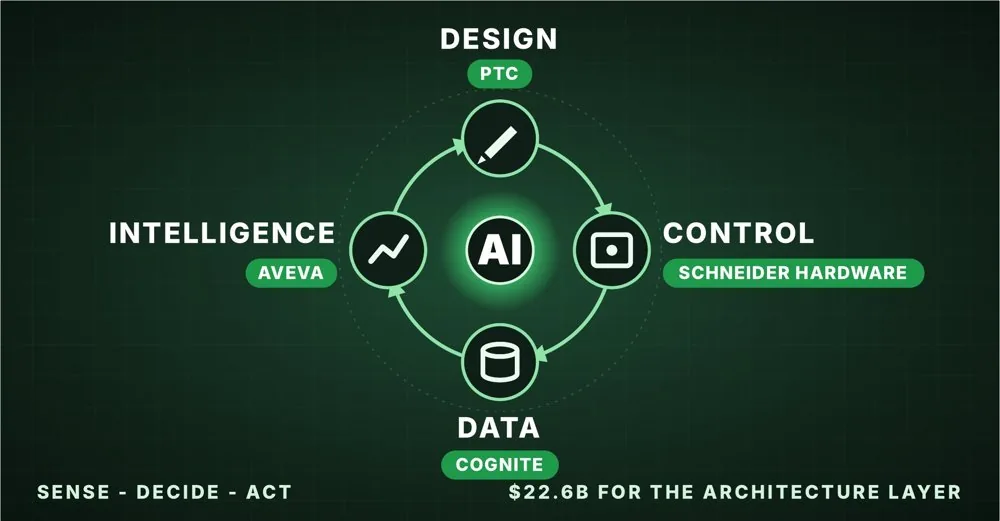
Schneider bought the design layer. PTC makes the CAD and product-lifecycle software that manufacturers use to design what they build.
Put that next to what Schneider already owns. AVEVA runs industrial operations. Cognite, a $3.1 billion industrial data and AI deal Schneider signed this summer, makes operational data usable by AI. Schneider’s own hardware controls the physical assets.
Design. Control. Data. Intelligence. Schneider now holds all four. Its own announcement says the goal is to drive outcomes “from any system of design, control, data and intelligence” and to bridge the physical and digital worlds across the whole lifecycle.
So, here’s what I’m telling you: That’s not a product strategy. That’s a convergence strategy.
2. Why does this deal read like the Strong Force playbook?
Strong Force’s core argument has three parts. Models are getting cheaper and more interchangeable. Agentic coding is collapsing the time it takes to build software. So the value moves to what Strong Force calls Applied Intelligence — the systems that select, route, govern, integrate, and execute AI in real operations.
Now look at Schneider. Software mega-deals have been rare in 2026 because buyers are nervous that AI can rebuild applications in weeks. Schneider paid a 42% premium anyway — and gave up close to EUR 15 billion in market value the day it announced the deal.
Why take that hit? Because Schneider isn’t paying for code. Code is getting cheaper every month. It’s paying for position in the deployment architecture — the place where AI actually touches a factory, a grid, or a data center.
So, here’s what I’m telling you: That’s the Strong Force thesis, executed by a company worth roughly EUR 170 billion, with its own money.
3. What does convergence look like on a plant floor?
At Rockwell, I worked on control systems where a wrong decision wasn’t a bad report. It was a stopped line, or worse. Those systems were deterministic for a reason.
What’s changing now is the loop. A design change in PTC can flow into a digital twin. The twin feeds the control system. Sensors report back what actually happened. AI closes the loop — it senses, decides, and acts, with governance a plant manager can trust.
That closed loop is the prize. Whoever controls it controls how AI runs inside the operation — which model gets used, where the data goes, and who keeps the intelligence the operation generates.
That’s why an energy and automation company just became one of the biggest industrial software companies on the planet.
So, here’s what I’m telling you: You can’t own the loop if you only own one piece of it.
4. Where does Strong Force sit in this picture?
Right in the middle of it.
Strong Force saw this convergence coming years ago and filed on it early, with priority dates going back to the mid-2010s — before the current AI wave. Its co-founder, Charles Cella, has been ranked the most prolific individual AI patent filer in the US in recent years. The estate now runs to roughly a thousand patent assets, with disclosures averaging around 450 pages each.
The estate maps to the same three layers Schneider just paid to assemble
- AI enabling infrastructure — the data, sensing, and connectivity that feed AI at the edge and in the data center.
- AI deployment architectures — agentic orchestration of software-defined assets and workflows, multi-agent coordination, and governance.
- AI-driven systems — digital twins, control towers, and closed-loop systems that sense, decide, and act across an enterprise.
That third layer is the loop I described above. It’s exactly what a design-plus-control-plus-data company is built to run.
To be clear, I’m not saying any patent reads on Schneider or PTC. That’s for lawyers, not columnists. What I am saying is simpler.
So, here’s what I’m telling you: Schneider just put a price tag on the architecture layer. The rights covering how that layer works matter a lot more today than they did last Friday.
5. What does this mean for you if you’re not Schneider?
You don’t have $22.6 billion. Neither do I. But the lesson scales down — and this is where Strong Force gets interesting for operators.
Agentic AI is about to let anyone copy your process, your workflow, and your customer experience in weeks. Speed won’t protect you. Operational excellence won’t protect you. Your competitor will have the same tools by next quarter.
Schneider protected its position the expensive way — it bought the architecture. Strong Force offers a different route. It isn’t trying to license its estate one patent at a time. It wants to work category by category — partnering with the leaders in a segment, or letting a company secure the rights in its category outright.
That changes the question for every operator. It’s no longer just “how do I use AI?” It’s “who will own the rights to how AI runs in my category — and will it be me or my competitor?”
Three questions worth asking now
- Where does AI actually touch my operation — and who controls that layer?
- If a competitor locked up the rights to how AI runs in my category, what would that do to me?
- Can I secure that position before someone else does?
The big players are answering those questions with checkbooks. The rest of us need to answer them with strategy — and soon.
The bottom line
Schneider just told the market, in its own words and with its own money, where the value in AI is going. Not to the model. To the architecture that puts the model to work. That’s what Richard Spitz and the Strong Force team have been saying — and building toward — for years.
Article 1 asked whether this work was legitimate. I checked, and it is. Article 2 asks a sharper question: now that a EUR 170 billion company has priced the architecture layer, who holds the rights to how it works?
I’m still treating this as a thesis, not a conclusion, and I’m actively trying to prove myself wrong.
If you see it differently — or you want to talk about what owning the architecture could mean in your category — I’d genuinely welcome the conversation.
Read Article 1: I Went Looking for a Way to Protect My IP in the Age of AI. I Didn’t Expect to Find the Alpha Asset in the Room.
A word on the Strong Force estate
Filed early on the layer Schneider just priced
Strong Force filed on the convergence of AI and enterprise architecture with priority dates reaching back to the mid-2010s — before the current AI wave. Its estate of roughly a thousand patent assets spans AI enabling infrastructure, AI deployment architectures, and AI-driven closed-loop systems. Rather than licensing one patent at a time, Strong Force works category by category — partnering with segment leaders or letting a company secure the rights in its category outright.
Sources
- Schneider Electric is buying industrial software maker PTC in a $22.6 billion deal — Quartz, Oct 5, 2026
- Schneider Electric to acquire PTC for $22.6bn — Silicon Republic, Oct 5, 2026
- Schneider Electric buying PTC for $22.6 billion — Axios, Oct 5, 2026
- Schneider Electric to buy US software firm PTC — Reuters via Euronext, Oct 5, 2026
- Schneider Electric to buy AI software firm Cognite for $3.1 billion — Reuters via Stockopedia
Kip Dodson is the founder of Dodson Management Consulting. This piece reflects his personal perspective. It is not investment advice and is not an offer to buy or sell any security. Originally published at dodsonmc.com/GS.
Previous in the series: Part 1: I Went Looking for a Way to Protect My IP in the Age of AI. I Didn’t Expect to Find the Alpha Asset in the Room.