
Shifting Competitive Moats and the Age of Agentic AI Architectures in Video Ecosystems
The Software Moat Vaporized
For three decades, software has been a powerful source of competitive advantage. In SaaS platforms, compounding growth arose from speed, open-source ecosystems, scale and network effects. Leaders increasingly relegated intellectual property from its traditional role as a competitive moat to a primarily defensive role.
Coding agents have fundamentally changed the economics of software. Platforms that required years of engineering effort can be replicated in days, and non-engineers can vibe code very useful agents and applications. The competitive moats of the last few decades are vaporizing. Even frontier AI models struggle to hold durable advantages as capabilities are rapidly distilled and diffused across industry at unprecedented speed.
All businesses that have relied on software to create advantages need new, durable competitive moats.
A New Agentic Architecture for Everything
Coding agents that can design, generate, test, and orchestrate software, including AI, will also unlock a fundamental shift in the architecture. Soon, AI will consist of much more than individual agents taking on a task. A multitude of agents and other AI systems will be chained together in systems-of-systems, where context-capable AI collectively understands and reacts to dynamic conditions and orchestrates the assets and workflows of the world. Enterprises that adopt these new agentic-orchestration architectures will have large operational advantages, but only if they can establish durable moats around them. This is not just another technology cycle. It is a structural shift in how enterprise value is created.
Return to the Patent Moat
Interestingly, as AI democratizes innovation, it simultaneously elevates the strategic value of one of the oldest forms of competitive protection: broad, system-level patent rights.
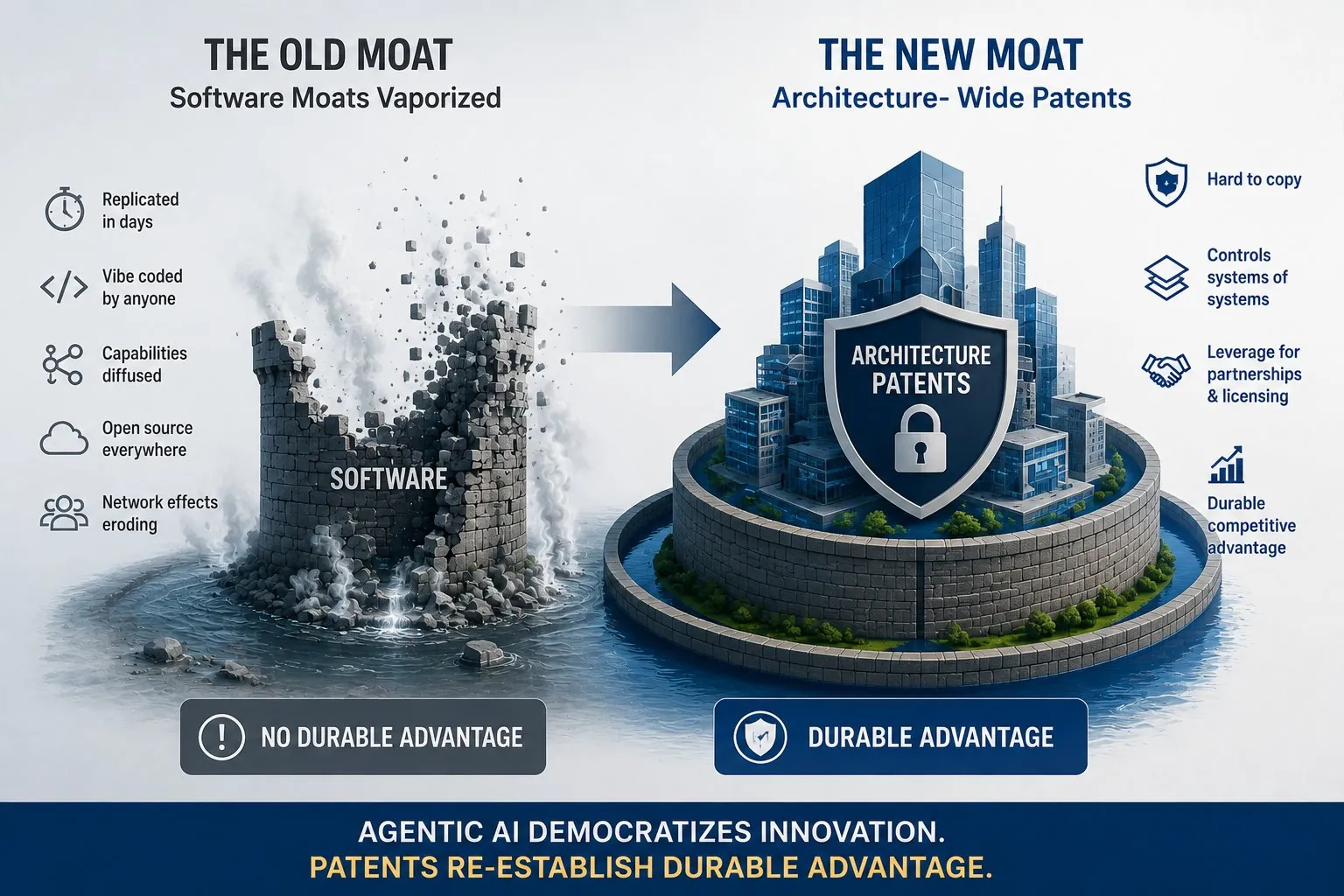
Unlike other forms of intellectual property, patents provide legal control over AI systems-of-systems regardless of how a competitive system is created. They are the one durable competitive moat that stands against copying, diffusion, distillation, reverse engineering, and even independent creation.
Live Video is Ground Zero
Live video is among the first industries that will feel the revolution, because media is already almost entirely software-defined. Content, distribution, advertising, rights management, and audience measurement are all digital, and every asset already carries rich metadata and a persistent identity. There is no factory floor to retool, so every layer of the media value chain is available to be reorganized by agentic AI immediately.
Live video is being reshaped by a second force on nearly the same timeline. Accelerated semiconductors, purpose-built for AI inference, are changing where and how video is processed, pushing heavy computation to data centers and letting viewers move fluidly among entertainment, social, work, and live feeds on whatever screen is in front of them. Thanks to agentic coding and orchestration, and the massive expansion of data center capacity, existing workflows such as billing and compliance, hyperpersonalization, and AI-native production can now all operate together, in real time, at scale, while preserving the rights and governance structures media companies and rights holders have spent decades building.
A personal AI agent will blend today’s fragmented, walled-garden services into one coherent screen, creating new ecosystems while leaving the underlying walled-garden business model intact, so media and content businesses can grow rather than be disintermediated. For rights holders, sports leagues, and distributors, the strategic question is no longer which platform reaches the most viewers. It is who owns the architecture that decides, in real time and at the level of the individual viewer, how content, rights, and advertising are combined, and how that decision layer is protected once every competitor has access to the same underlying AI models.
In video, the new architecture will include adaptive channel infrastructure, agentic orchestration, dynamic trust boundaries, cloud and edge personalization, and rights-aware AI.
IP in video ecosystems
Patents have long played a major role in how video ecosystems are orchestrated. Rather than lawsuits, strong patents create conversations, cross-licenses, and profit-sharing, ultimately shaping entire ecosystems around a shared technical foundation. Qualcomm, ARM, Dolby, InterDigital, and the MPEG LA patent pool all built enduring value this way, not through courtroom victories, but by owning architectures so foundational that the rest of the industry had a rational economic interest to collaborate, rather than seek to avoid.
Agentic AI is about to make that model relevant well beyond communications and semiconductors. Video will be one of the earliest and clearest examples.
If any of these questions gives you pause, we’d welcome a conversation about the art of the possible.
About the Authors
Charles Cella and Marc Todd bring complementary expertise at the intersection of intellectual property, enterprise architecture, artificial intelligence, and technology commercialization. Together, their work spans the creation, protection, and deployment of foundational technologies that define new industries.
Charles Cella, Co-Founder and Managing Director of Strong Force Innovation Portfolios, has focused for decades on the architectures of technology convergence and the converged systems that are built on them. Over the last decade, he has been one of the world’s most prolific inventors in the converged AI architectures and AI-driven systems-of-systems. Across multiple verticals, Strong Force develops patents that become durable assets for enterprises and others, providing competitive moats, strategic bargaining leverage, profit generation, and long-term enterprise value. He has been recognized by IAM as a leading intellectual-property strategist and by GreyB as the top filing inventor of U.S. artificial-intelligence patents from 2019 through 2025.
Marc Todd focuses on the architecture of technology platforms—how foundational systems are conceived, engineered, commercialized, and deployed at enterprise scale. A technology entrepreneur, inventor, and systems architect with more than 30 years of experience, he is Founder and CEO of Skreens, where he leads the development of AI-native architectures for live video orchestration, hyper-personalization, and next-generation media platforms. Previously, Todd founded IneoQuest Technologies, a pioneer in IP video monitoring and analytics that helped accelerate the industry’s transition from traditional broadcast infrastructure to software-defined video delivery. Throughout his career, he has focused on identifying major architectural shifts before they become mainstream, resulting in numerous U.S. patents spanning streaming media, networking, semiconductor, cloud video infrastructure, and interactive advertising. His current work explores how agentic AI will reshape media platforms, digital experiences, and the future architecture of television.
The next era of enterprise value will be defined not by software implementation alone, but by the convergence of system architecture, agentic AI, and foundational intellectual property.